Matsu
Salmon
Delaini from Talkeetna
Anchorage Zoo
Earthquake Park
Ships Creek
Botanical Garden
Downtown Anchorage
Native Indian Cultural Center
Seward
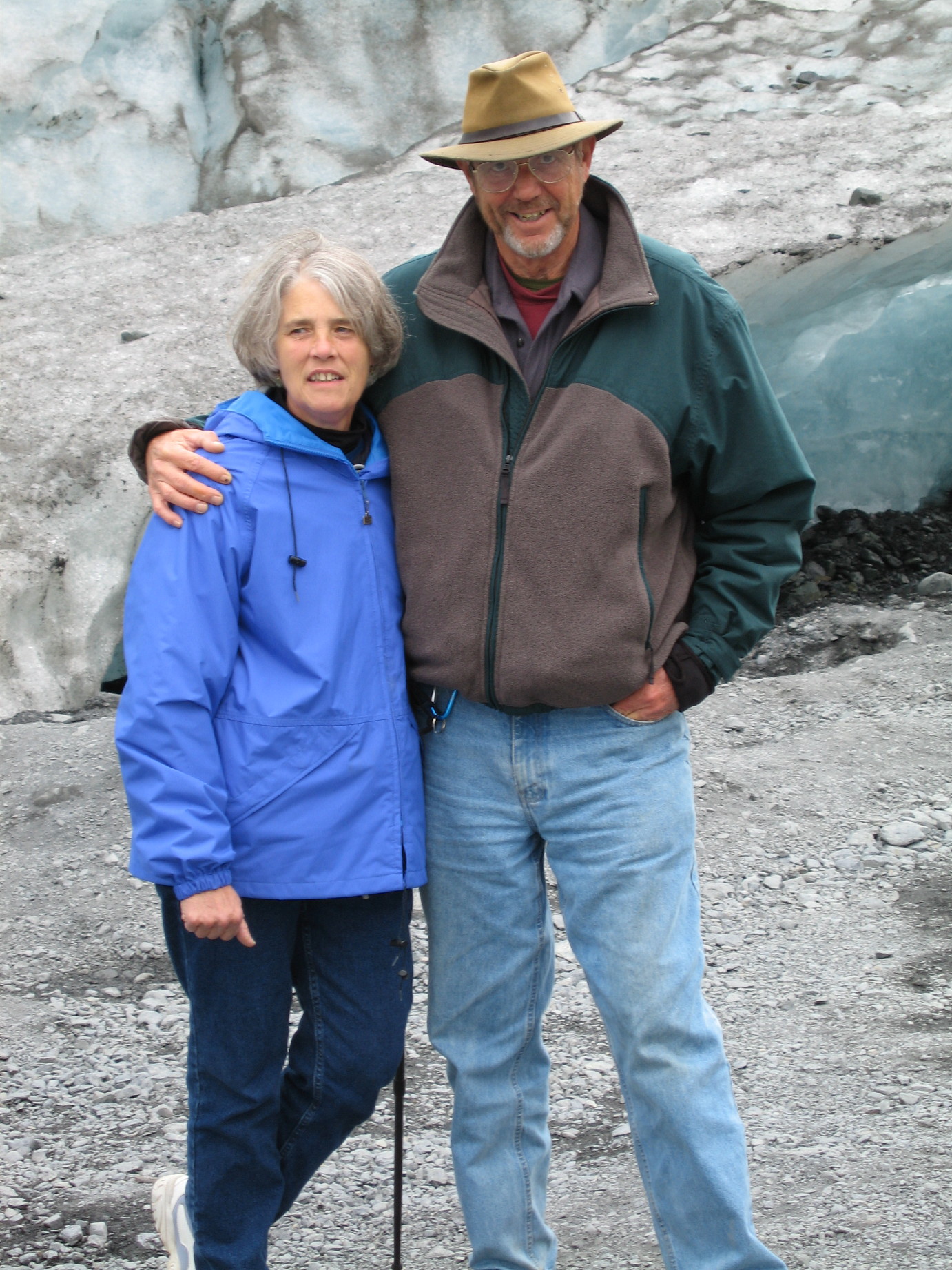
Carl & Charmi at a Glacier
Matsu
Salmon
Delaini from Talkeetna
Anchorage Zoo
Earthquake Park
Ships Creek
Botanical Garden
Downtown Anchorage
Native Indian Cultural Center
Seward
If you’ve been following the blog at all, you know that Alaska is expensive. You have a pretty good idea how tourists help keep it that way. But how did it all start, and what else fuels the economy ? The answer to that question is probably simpler here than most geographic or governmental areas, despite the relatively large mass of land. Part of this relates to the small population, only about 600,000 residents….. Anyway, to start from somewhere near the beginning, the First Nation folks (Athabascans, Inuits, etc.) crossed the Bering Strait about 12,000 years ago. Fairly quickly they thinly distributed themselves throughout what is now known as Alaska— and beyond for that matter, including quite probably most of North and South America. For well over 11,000 years the First Nation people remained hunter/gathers living close to nature and inhabiting, but not uniting or “developing”, in any real sense, fairly discrete geographical areas. Then, along came the Russians, possibly as early as the 17th century, primarily interested in furs, and who claimed the territory as their own. So Alaska became an area to be trapped and hunted for it’s many different and available fur bearers. Gradually, the Americans moved into the fur trade, and Russia, sensing that in the longer term that it could not sustain against the American influence, sold “Seward’s Icebox” to the U.S. just after the Civil War. Still, there was no significant migration to the area until the gold rushes that began in the 1890’s. But gold quickly brought adventurers of all descriptions and small cities and towns developed, mostly on rivers to which supplies could be shipped or in areas where gold was discovered. Many of the towns went from boom to bust in a matter of a couple years. Overnight, gold seekers would pull stakes and move on to more promising claims. But, in fact, some folks stayed and settled down and present day cities like Fairbanks, Skagway and Nome got their start. Other mineral discoveries such as copper and coal kept the extractive industries active if not thriving. Along with commercial salmon fishing, and the still present fur trade, this provided the “pioneers” with jobs. But growth, after the gold rush, remained modest till World War II….. The Japanese threat (Unalaska in the Aleutians was actually attacked by Japan) refocused attention on Alaska. The Alaskan/Canadian Highway was built in nine months in 1942 and provided the first land route from the U.S.to Alaska. The military also built a number of army (Ft. Richardson, Wainwright) and air bases (Elmendorf, Eielson) as well as Coast Guard facilities (Ambercrmbie on Kodiak). The U.S. government also provided homesteading incentives to draw farmers to the Mat-Su Valley to grow food for the troops. All this not only provided new transportation possibilities and jobs for the civilians, but, following the war, many veterans returned and settled in the land they had come to love…. By the late 1930’s, the possibility of oil in that there ice was beginning to draw the attention of both the major and independent oil companies. Visions of oil may have been the driving force behind statehood for Alaska (and the associated bureaucracy), which was finally achieved in 1959, but the oil industry really didn’t become paramount until the late 60’s or 70’s, and is primarily identified with the development of the oil pipeline from Seward ( an ice free port) to Prudhoe Bay. In some sense, oil continues king in Alaska and major skirmishes are taking place every day pitting the oil interests and job creation advocates against environmentalists and just plain folks who consider further oil exploration inimical to their Alaskan dreams, mostly owing to the idea that oil has put Alaskans on the “welfare dole” since most taxes are covered by oil royalties and each Alaskan resident receives an oil check annually. This year’s governor’s contest revolves mostly around oil issues, though the personal honesty of the incumbent is also a factor. (Something new, huh?)…. Over roughly the past thirty years, tourism has risen to it’s present position of eminence. Whole sectors of the state are almost entirely dependent upon tourists (and associated activities such as fishing, river rafting, museum going, kayaking, railroading, sea life cruises, gambling, theatre, restaurants, and on and on, right on down to bird watching— or for you birders, right on up….. This is just a thumbnail sketch, but there you have it: hunting/gathering, fur, gold, commercial fishing, extractive minerals, military, government, oil, and tourism….Alaskans feel that though the years they’ve been taken advantage of and have little to show for all that’s been removed from the state— and they certainly have a point. As a territory, they got few benefits from Washington, but Washington protected the companies that were extracting their resources. So what’s the point of all that I’ve written thus far? Simple. It’s payback time! That’s the reason all these tourists are being soaked!!!…. Charmi leaves tomorrow, so I’ll be a bit lonely for a while. To help me forget, I’m headed on an all day charter on a 44 foot Viking, shall we say, fishing boat or motor yacht. I hope to be back to you soon with some more fishing stories. I know you all just can’t wait!!!